Media, Diaspora and Conflict: Nationalism and Identity Amongst Turkish and Kurdish Migrants in Europe by Janroj Yilmaz Keles
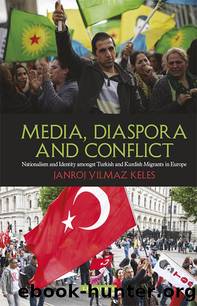
Author:Janroj Yilmaz Keles [Keles, Janroj Yilmaz]
Language: eng
Format: epub
Tags: Ethnic Studies, Emigration & Immigration, Minority Studies, History, Europe, Political Ideologies, Social Science, Political Science, Nationalism & Patriotism, Islamic Studies, Communication Studies, Language Arts & Disciplines, Law, General
ISBN: 9780857739148
Google: s7iKDwAAQBAJ
Publisher: Bloomsbury Publishing
Published: 2015-08-21T11:09:46+00:00
Conclusion
The media consumption of Turkish and Kurdish communities has shifted in part from the media of the countries of settlement to the Kurdish and Turkish media (Zentrum für Türkeistudien 1997, Weià and Trebbe 2001, GöfaK-Studie 2001, Robins and Aksoy 2001, Hafez 2002). Generally speaking, this type of media creates a new form of communication between âthose who move and those who stayâ (Appadurai 1995a: 283).
My research on media consumption shows that the Turkish and Kurdish migrants have developed their own media culture, which shapes their identities and relations with each other over belonging to the Turkish or Kurdish nation, and taking a position in the ongoing ethno-national conflict in the homeland. In this sense, the Turkish and Kurdish media exert a huge influence on formation of migrantsâ ethnic identity, also differentiate them into âusâ and âthemâ. This has contributed to the hegemonic struggle between both migrant groups around certain banal nationalist terminologies in the countries of settlement. In this process the Turkish media has opened up a âfrontâ amongst Turkish and Kurdish migrants who follow the Turkish media. This has unintentionally contributed to creating opposition among Kurds who feel that the Turkish media mainly portrays them in a negative light. This alienation from the Turkish media has led many Kurds to embrace Kurdish media and the values of the Kurdish national movement. The Kurdish media has politically and culturally empowered Kurdish migrants to create a sense of belonging to their homeland, Kurdistan. Yet it has also alienated some Kurds with its highly âpoliticisedâ programmes.
Turkish and Kurdish migrants position themselves through different terms of identification with their homeland, which they receive from the media and from existing Turkish and Kurdish communities in the countries of settlement. This reconceptualisation of ethnic identity is taking place when Kurdish migrants identify themselves as Kurdish rather than conforming to the Turkish stateâs demands they identify as Turkish. When Turkish migrants realise that some Kurdish migrants in diaspora are reconceptualising their identity in this way, they often react with shock. This leads to conflict between Turkish and Kurdish migrants. Indeed, many Turkish migrants feel that it is the European countries that encourage Kurds to express their identity as Kurdish. This discourse has been used by the Turkish media and state. Kurds, on the other hand, enjoy the freedom to define their ethnic identity as Kurdish in the diaspora.
While using the term âKurdistanâ can be grounds for prosecution in Turkey, in the diaspora Kurds can imagine and construct Kurdistan as a country, albeit without legal status in international relations. However, this imagined Kurdistan becomes meaningful for Kurdish and Turkish migrants as well as citizens of the countries of settlement. Kurds and Kurdish issues become visible amongst migrants and these issues are huge challenges to some Turkish migrants. The political and geographical terms and representations of Kurdishness become a part of Kurdish migrantsâ publicly expressed identity in multicultural societies. We are currently witnessing a period of transition among Turkish and Kurdish migrants, an adaptation to the values of a multi-cultural society.
Download
This site does not store any files on its server. We only index and link to content provided by other sites. Please contact the content providers to delete copyright contents if any and email us, we'll remove relevant links or contents immediately.
| Anthropology | Archaeology |
| Philosophy | Politics & Government |
| Social Sciences | Sociology |
| Women's Studies |
Cecilia; Or, Memoirs of an Heiress — Volume 1 by Fanny Burney(32561)
The Great Music City by Andrea Baker(32021)
Cecilia; Or, Memoirs of an Heiress — Volume 2 by Fanny Burney(31958)
Cecilia; Or, Memoirs of an Heiress — Volume 3 by Fanny Burney(31944)
We're Going to Need More Wine by Gabrielle Union(19050)
All the Missing Girls by Megan Miranda(16038)
Pimp by Iceberg Slim(14515)
For the Love of Europe by Rick Steves(14149)
Bombshells: Glamour Girls of a Lifetime by Sullivan Steve(14078)
Talking to Strangers by Malcolm Gladwell(13375)
Norse Mythology by Gaiman Neil(13372)
Fifty Shades Freed by E L James(13245)
Mindhunter: Inside the FBI's Elite Serial Crime Unit by John E. Douglas & Mark Olshaker(9346)
Crazy Rich Asians by Kevin Kwan(9295)
The Lost Art of Listening by Michael P. Nichols(7507)
Enlightenment Now: The Case for Reason, Science, Humanism, and Progress by Steven Pinker(7315)
The Four Agreements by Don Miguel Ruiz(6767)
Bad Blood by John Carreyrou(6625)
Weapons of Math Destruction by Cathy O'Neil(6283)
